
Furniture Moving Tips to Avoid Damage During Relocation
Furniture moving looks simple from the outside. It is not. One scratch on a wooden table, one cracked mirror, one sofa leg that gets dragged the wrong way, and suddenly the whole move feels more expensive than it should have been. In Abu Dhabi, that risk goes up fast because you are not just dealing with boxes and trucks.
You are dealing with building rules, elevators, parking space, security desks, heat, timing, and sometimes people who think “we’ll manage” right up until something breaks. The best way to avoid damage during relocation is to prepare furniture the right way before moving day, use proper handling during loading and unloading, and plan the move around the real conditions in Abu Dhabi.
Honestly, most damage does not happen because movers are careless. It happens because furniture was not packed properly, the route was not checked, or the timing was rushed because someone forgot to book the elevator or get permission from the building.
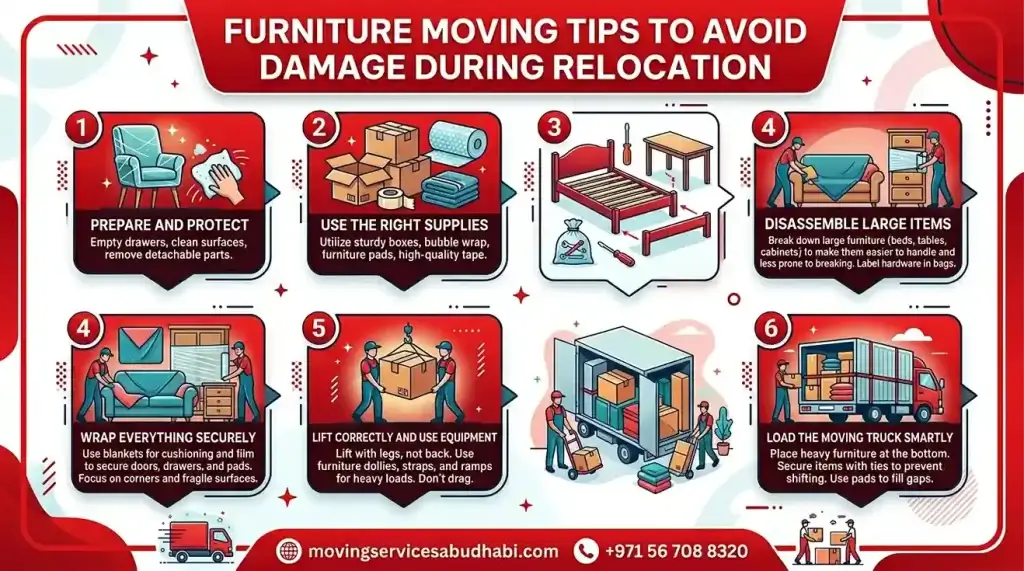
Table of Contents
What actually causes furniture damage during relocation
Here’s the thing. Furniture does not usually get damaged in some dramatic accident. It gets damaged through small mistakes. A table is moved without removing the legs. A wardrobe is dragged instead of lifted. A sofa is wrapped in a thin sheet and then rubbed against a wall in a narrow corridor. A dining chair gets loaded last, shoved into a corner, and comes out with torn fabric or a bent frame.
We’ve seen this happen a lot in Abu Dhabi. Apartment moving in tall towers can be tricky because lifts are shared, hallways are tight, and security teams do not always allow movement at the time you wanted. Villa moving sounds easier, but then you get wide furniture, staircases, garden access, and bigger items that need proper dismantling. Furniture moving in both cases needs a bit of patience. A rushed move almost always creates damage somewhere.
Another common problem is timing. In the UAE, heat is no joke. Wood expands a little, leather gets sticky, and people get tired faster than they expect. When a moving crew is working under pressure in hot weather, mistakes happen more easily. Someone lifts from the wrong side. Someone forgets to secure a drawer. Someone leaves a glass table top standing too long without support. That is how damage starts.
Start with the furniture itself
Before anything is loaded, look at each item properly. Not every piece of furniture should be handled the same way. A solid wood bed frame is not the same as a laminated TV unit. A leather sofa is not the same as a fabric sofa. Glass furniture needs one kind of protection. Mirrors need another. Even simple items can surprise you. We’ve seen cheap-looking chairs survive a move better than expensive ones because they were packed better.
If you are arranging apartment moving or villa moving, this is the part people skip. They just say, “take everything.” That is risky. The better approach is to separate items into categories:
- fragile items like glass tables, mirrors, display cabinets
- heavy items like wardrobes, beds, drawers, and sofas
- awkward items like large dining tables, recliners, and office desks
- items that need dismantling before moving
This makes the move easier for movers and packers UAE teams too, because they can choose the right protection and the right loading order.
Dismantling is not optional for many pieces
A lot of furniture damage happens because people try to move large items in one piece when they should be dismantled. Bed frames, wardrobes, office desks, modular shelves, and some dining tables usually move better after careful dismantling. That does not mean taking everything apart blindly. It means knowing what should come off and what should stay.
A common mistake is removing screws and hardware without keeping them properly. Then the furniture reaches the new place and nobody knows where the bolts went. Another mistake is forcing old fittings during assembly. That is how chipboard cracks or joints loosen. If the furniture was already a bit weak, one bad move can finish it off.
In office relocation, this matters even more. Office desks, conference tables, cabinets, and workstations often need labeling before dismantling. If not, employees end up confused later and IT setup gets delayed because the furniture is not ready. We’ve seen office moves where the furniture arrived on time, but half the team could not settle in because the setup was incomplete. Small issue, big delay.
If you are planning a move, it helps to check the service pages for the exact type of move you need, like apartment moving, villa moving, or office relocation. Different moves need different handling. That part matters more than people think.
Wrapping furniture properly saves money later
Good wrapping is not about making the furniture look neat. It is about stopping friction, dust, moisture, corner damage, and pressure marks. Thin sheets are not enough for expensive or delicate furniture. Bubble wrap, stretch film, thick blankets, foam sheets, and corner protectors all have their place.
The tricky part is wrapping in the right order. If you trap dust or sharp edges under a layer, that can cause scratches. If you wrap too tight, you can damage delicate finishes. If you wrap too loosely, the item moves inside the truck and rubs itself to death. We’ve seen polished furniture come out with marks just because it was wrapped in a hurry.
Glass and mirrors need extra care. Never rely on one thin layer. Secure them vertically, not flat, whenever possible. Flat transport is where a lot of breakage happens. And for wooden furniture with sharp corners, protect the corners first. Most of the visible damage starts at the edges.
Abu Dhabi building rules can ruin a move fast
Most people underestimate building management restrictions. In Abu Dhabi, some buildings are strict about move-in and move-out timings. Some want elevator bookings in advance. Some require a security deposit. Some ask for the truck plate number. Some need a move permit. And some will simply stop the move if you show up at the wrong time.
This creates problems for furniture moving because the crew may be ready, but the building is not. Then furniture waits in the lobby, in the parking area, or in the truck. That is where damage can happen. Heat, impatience, and repeated handling are not a good combination.
We’ve handled moves in Musaffah, Reem Island, and Khalifa City where the delay was not the packing. The delay was the building desk, elevator queue, or parking access. One client had a full living room set waiting downstairs because the service lift was booked by another tenant. By the time it came free, everybody was tired and the sofa had been shifted three times already. That kind of repeated movement is exactly what causes scratches and torn fabric.
Always confirm:
the elevator booking time
security access requirements
parking permissions for the truck
allowed move hours
any building fines or deposit rules
A move can go smoothly on paper and still turn into a mess if one of these is missed.
Timing matters more than people realize
The best moving time is not always the cheapest or most convenient. In Abu Dhabi, early mornings are usually easier. By midday, heat becomes a real issue. Afternoon moves can drag because people slow down, parking gets tighter, and furniture stays outside longer than it should.
Office relocation is especially sensitive to timing because staff need to get back to work, IT setup has to happen, and management often wants the move done within a certain window. If the moving team arrives late, the whole office day gets disturbed. If furniture arrives before IT is ready, the items sit around and block the space. Not ideal.
A simple timing mistake can damage furniture too. For example, if a crew leaves mattresses or upholstered chairs in direct sun too long, fabric can get stressed. If wood items are kept in a hot truck for too long without ventilation, finishes can suffer. It is not always dramatic damage, but it adds up.
The loading sequence should be planned, not guessed
Loading furniture into the truck is where experience shows. Heavy items should not be tossed in first without thought. Delicate pieces should not be buried under bulky furniture. Sofas should not rub against rough metal edges. Chairs should not be stacked badly just to “save space.”
A clean loading plan usually looks like this:
- heavy and stable items first
- padded items and medium furniture next
- fragile items upright and secured
- loose parts and hardware packed separately
- final check before closing the truck
That sounds simple. In practice, it takes discipline. The team has to keep checking straps, spacing, and protection. A truck that is packed too tightly can cause more harm than a truck that is packed carefully but with a bit of breathing room.
Furniture moving is not a race. A small delay while rechecking an item is better than paying later for a damaged cabinet door.
Common mistakes that lead to damage
Most furniture damage I have seen comes from the same repeated mistakes. Not fancy problems. Basic ones.
- leaving drawers full during lifting
- moving wardrobes without dismantling
- using weak wrapping on polished surfaces
- forgetting corner protection
- dragging furniture across floors
- loading glass items flat instead of upright
- not labeling dismantled parts
- ignoring building access rules
- rushing because the elevator window is short
These mistakes are simple, but they cost real money. Sometimes the damage is obvious. Sometimes it is not. A hidden crack in a wooden frame may show up later. Loose joints may not become clear until the furniture is reassembled at the new place.
We’ve seen customers blame the move when the real issue was pre-existing weakness. That is another reason to inspect items before moving day. If something is already loose, weak, or damaged, it should be documented first. Saves trouble later.
A practical checklist before moving day
This is the kind of small checklist that actually helps.
- measure large furniture against doorways and corridors
- book the elevator and confirm the timing
- check parking access for the moving truck
- remove fragile items from drawers and shelves
- take photos of valuable furniture before packing
- label dismantled parts in small bags
- wrap corners and glass surfaces properly
- keep essentials separate from furniture items
Do these things and the move gets easier almost immediately. Skip them and even a simple apartment moving job can turn into a long day.
What goes wrong with office furniture
Office relocation has its own problems. Furniture damage is only part of it. The real headache is when the move interrupts work. Employees are confused, desks are mixed up, and IT setup is delayed because equipment does not land where it should.
We’ve seen office chairs arrive without matching desks. We’ve seen conference tables packed but not labeled, so the wrong parts were assembled together. We’ve also seen computers and cable trays held up because furniture was not cleared out in the correct order. That slows the whole office down.
The best office moves are the ones where the furniture plan is written down clearly before the truck arrives. Who gets what desk, what gets dismantled, what goes into storage, what needs special handling. Simple things. But they save hours.
If the move is larger, it often helps to pair the furniture plan with movers and packers support so the team handles both packing and relocation in a coordinated way. That reduces confusion.
Why professional movers and packers make a real difference
Real talk. Hiring professional movers and packers is not just about convenience. It is about avoiding expensive mistakes. Good movers save time because they know how to handle furniture without trial and error. They reduce stress because you are not trying to manage tape, tools, wrapping, truck loading, and building access all at once. They also handle furniture more carefully because they do this every day.
That matters in Abu Dhabi more than people think. Building restrictions are not always flexible. Parking can be tight. Some moves need exact timing. Some furniture needs dismantling, some does not. A professional team understands these details and works around them instead of learning them the hard way.
And honestly, the cost of one damaged table, one broken glass panel, or one torn sofa corner can be more frustrating than the moving service itself. People usually realize this after the fact. We’ve seen that happen a lot.
FAQs
How do I protect wooden furniture during relocation?
Use thick padding, corner protection, and stretch wrap. Keep wooden items away from rough surfaces in the truck, and do not drag them across floors.
Should I dismantle furniture before moving?
Yes, for most large items. Beds, wardrobes, desks, and some tables move more safely after dismantling. Just keep all screws and fittings labeled properly.
What is the biggest risk during furniture moving in Abu Dhabi?
Usually it is not one single thing. It is a mix of building restrictions, elevator delays, parking issues, heat, and rushed handling.
How do I avoid scratches on glass and polished furniture?
Wrap them carefully, keep them upright when possible, and never let them touch unpadded metal or rough surfaces.
Furniture moving does not have to be stressful. But it does need planning. The people who protect their furniture best are usually the ones who slow down a little before moving day, check the building rules, pack properly, and avoid the usual rushed mistakes. That is what keeps furniture safe in Abu Dhabi, whether it is apartment moving, villa moving, or office relocation.