Office Relocation in Abu Dhabi – Timeline, IT Setup & Hidden Problems
Office relocation in Abu Dhabi is not just about shifting desks and chairs. It is about keeping the business alive while everything is being moved around it. Honestly, that is the part most companies underestimate. A move can look simple on paper, then the elevator booking slips, the IT setup is delayed, and half the team cannot work properly for a day.
If I’m being real, the hardest part is not the furniture. It is the downtime. It is the lost files, the network issues, the access card problems, and the pressure of trying to finish a move without interrupting clients or staff. That is why office relocation needs a proper timeline, a proper crew, and a team that understands how Abu Dhabi office towers actually work.
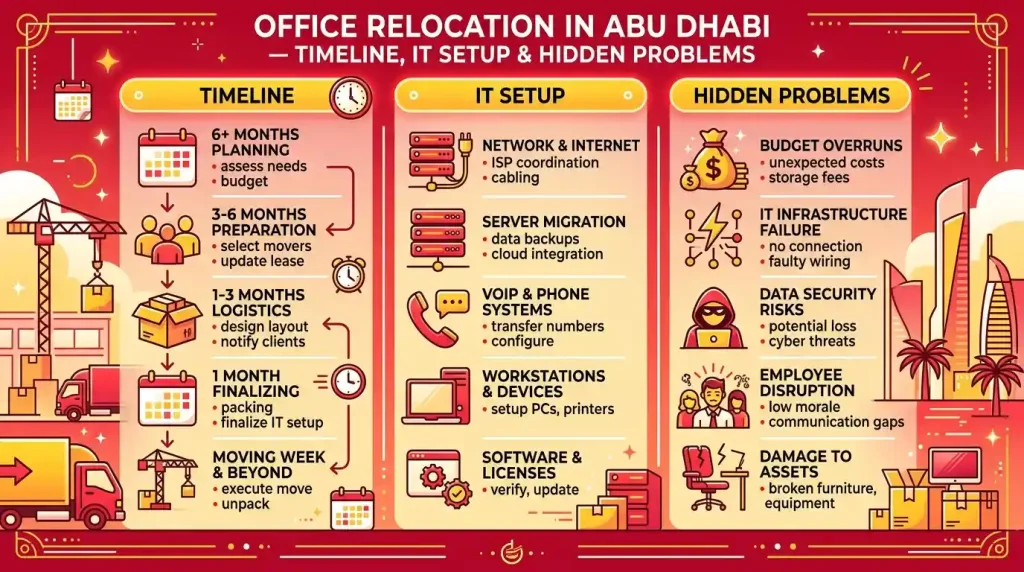
Table of Contents
Why office relocation in Abu Dhabi is more complicated than people think
Office relocation sounds straightforward until the building starts asking questions. Some towers want loading dock timing. Some want security approvals. Some want elevator bookings in advance. Some restrict move times to certain hours. And in Abu Dhabi, those things are normal.
We’ve handled moves in Musaffah, Reem Island, and Khalifa City, and the same pattern shows up again and again. The office is ready in theory, but the building is not ready in practice. A 1–2 hour wait for the service elevator can throw off the entire day. One missing approval can hold the truck at the entrance. One IT mistake can keep staff offline.
That is why office movers in Abu Dhabi are not just about transport. They are about coordination. They need to understand business timing, not just moving timing.
What a proper office move timeline looks like
A good office relocation timeline starts before move day. Too many companies leave the planning too late, and then everything gets compressed into one stressful window. That is when mistakes happen.
A normal office move should begin with a survey. The team checks how much furniture there is, what IT equipment needs special handling, where the loading access is, and whether the destination building has restrictions. Then the packing plan gets set. Then approvals. Then the actual move. If the IT work is part of the move, that needs to be timed too.
Most office moves take around 6–10 hours depending on size, but that is only when the plan is tight. A bigger business relocation can take longer if servers, workstations, and multiple departments are involved. And if the timing is wrong, the whole thing can spill into the next day.
That is where office relocation support for businesses becomes important. It gives the move a structure instead of turning it into a scramble.
The hidden problems most businesses forget during office relocation
This is the part people regret later.
The first hidden problem is internet downtime. A lot of companies think the move is done once the furniture arrives. It is not. If the internet is not ready, the staff cannot work. If the network is not configured, the printers do not work. If the server is not handled carefully, the whole office can be stuck.
The second hidden problem is printer and workstation setup. Monitors, cables, docking stations, power strips, and desktop units all need to be tracked properly. If not, somebody spends half the afternoon looking for one cable and one adapter.
The third hidden problem is files. Physical paperwork still matters in many Abu Dhabi offices. If files are not labeled properly, departments get mixed up. Then staff waste time searching instead of working.
The fourth hidden problem is permissions. Office towers often need building approval, elevator booking, and loading dock coordination. Some also need after-hours move permission. We’ve seen companies skip this and regret it later.
The fifth hidden problem is staff coordination. People assume everyone will just follow the move plan. In reality, someone is still using a desk. Someone else is not packing their drawer. Someone else is looking for keys. One small delay becomes five small delays.
Why IT setup can make or break the move
IT setup is where a lot of office relocations go wrong.
The furniture can arrive on time and still nothing works. That is because the move is not finished until the network is live, the printers are working, the devices are connected, and the team can actually log in and continue their work. In modern office relocation, IT is not a side issue. It is the core issue.
We’ve seen offices lose half a day because the internet handover was delayed. We’ve seen printer setup get pushed back because the cables were packed in the wrong box. We’ve seen workstation relocation become messy because nobody separated department equipment before the move.
If your business depends on computers, internet, and files, then the move needs to be planned around IT from the start. That is one of the reasons companies choose movers and packers in Abu Dhabi instead of trying to manage the job with a random labour team.
Office movers versus doing it yourself
DIY office relocation looks cheaper at first. It often is not.
The real cost is downtime. It is the lost productivity. It is the staff sitting around waiting for desks, files, and internet. It is the risk of damaging monitors or losing important paperwork. And if the building rules were missed, it is also the delay at the gate.
Professional office movers understand the moving sequence. They know how to pack workstation equipment, how to label departments, how to move office furniture without confusion, and how to keep the day moving. That is why professional movers and packers in Abu Dhabi are often the better choice for business clients.
DIY can work for a tiny office with almost no equipment. But once there are multiple desks, IT gear, files, and deadlines, the risk rises fast.
Common office relocation problems in Abu Dhabi
Office moving in Abu Dhabi has its own repeat problems.
Parking can be tight near office towers. Loading docks may only be available at certain times. The service elevator may already be booked. Security may ask for approval or ID details before letting the crew in. Some towers also have strict timing rules, especially in busy business districts.
Timing is another issue. If the move happens during peak office hours, traffic can slow the trucks down. If it happens in summer, the heat makes packing and carrying slower. If the move starts late, the whole schedule gets squeezed.
Then there is equipment damage. A monitor that was not wrapped properly. A workstation that was loaded badly. A printer that got shoved into the wrong box. Those mistakes look small until they cost time and money.
And yes, office relocation can also create confusion among employees. Some people do not know where to sit. Some cannot find their files. Some are waiting on IT. Some think the move is done, but it is not. That confusion is part of what good office movers are supposed to reduce.
Storage services during office relocation
Storage becomes useful when the move cannot happen in one clean step. That happens more than people expect.
A company may be downsizing and not need all its furniture right away. A phased relocation may mean half the office moves now and half later. The new office may not be ready yet. Or the landlord may delay the handover. In those situations, storage is the safer option.
A good moving company should be able to move furniture into storage first, then deliver it once the office is ready. That is why safe storage services if needed can save a business from forcing a bad move schedule.
Storage is especially helpful for excess chairs, unused desks, filing cabinets, and items that do not need to be in the new office on day one.
Office relocation checklist before moving day
Before the movers arrive, the business should do a few things early:
- Back up all files and important data
- Label departments and workstation equipment
- Disconnect internet and IT equipment properly
- Reserve the elevator and loading dock
- Notify staff about the move schedule
- Prepare the new office layout
- Set aside files, keys, and access cards
- Confirm parking and truck access
That sounds simple, but it saves a lot of pain later. One missing backup can slow the first day in the new office. One unlabeled box can waste half an hour. One missed access detail can hold the truck outside.
Permissions, approvals, and building rules
Office towers in Abu Dhabi are not always flexible. Many require approval before the move date. Some ask for tenant letters, company details, or move requests in advance. Others need elevator booking confirmation and security clearance.
If the move happens after hours, the building may still need permission. If it happens during office time, the building may need a time slot. If the loading dock is shared, the office may only get a short window. Those details matter.
We’ve seen companies get caught because they assumed the building would “sort it out later.” That rarely works. Office relocation is one of those jobs where the paperwork matters just as much as the furniture.
Why hiring professional movers and packers actually matters
Honestly, this is where the value becomes obvious. Professional movers save time because they already know the moving flow. They reduce stress because they handle the coordination. They prevent damage because office equipment is packed with care. And they make the move smoother because there is less confusion on the day.
In our experience, business owners do not usually regret paying for a proper move. They regret delays. They regret broken equipment. They regret staff sitting idle because the network was not ready. A professional team keeps the business moving while the office is being moved.
Local experience makes a difference
Office relocation in Abu Dhabi is not the same as office relocation anywhere else. You have tower rules, approvals, traffic timing, summer heat, and building access issues. A team that has worked across Musaffah, Reem Island, Khalifa City, and other parts of the city understands those problems before they happen.
One client told us the best part of their move was not how fast the trucks arrived. It was that the team kept everything calm. That matters in a business move. Calm coordination is often more valuable than speed alone.
FAQ
How long does office relocation take?
It depends on size, equipment, and building access. Small offices can finish faster, while larger offices with IT gear and multiple departments take longer.
What is office moving cost in Abu Dhabi?
It depends on office size, furniture volume, IT equipment, access, and whether storage is needed. The more complex the move, the higher the cost.
Do movers handle IT equipment?
Yes, if the team is experienced. IT gear needs proper packing, labeling, and careful handling to avoid downtime.
Can office relocation happen after working hours?
Often yes, but it depends on building approval and access rules. Many businesses prefer after-hours moves to reduce downtime.
Do you provide storage services?
Yes. Storage is useful for phased moves, delayed handovers, and excess office furniture that does not need to move right away.
Office relocation in Abu Dhabi works best when the move is treated like a business operation, not a basic truck job. That is how you protect time, equipment, and productivity while keeping the office running.